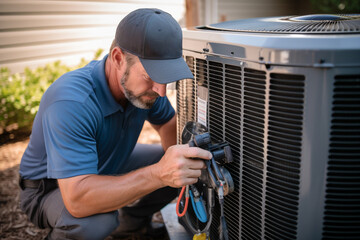
HEATING AND COOLING helps you avoid costly repairs and achieve better energy efficiency. It’s also important for keeping your home comfortable.
Your heating and cooling system consists of several components that work together to maintain your preferred temperature settings and balance humidity. We’ve broken down the basics to help you understand how these parts operate and interact:
Thermostat
The thermostat is the key to ensuring your home stays comfortable all year round. It allows you to set your desired temperature, and the HVAC system will turn on and off to keep it that way. A problem with the thermostat can cause your heating and cooling to work harder than necessary, leading to poor performance and higher energy bills.
Thermostats come in a variety of types, from electromechanical units that use bimetallic strips to digital, programmable models with digital displays and sensors. Regardless of the type, they all operate in essentially the same way. When a thermostat senses a shift in air temperature, it triggers action by closing or opening an electrical circuit. This circuit is closed when the air temperature falls below your set point, and it opens when the temperature rises.
Once the thermostat triggers a heating cycle, the furnace or heat pump kicks in to warm your home. The blower fan moves conditioned air through your home’s ductwork, and it exits into rooms via supply vents or registers. In systems with whole-home air filtration, the evaporator coil also pulls spent air from each room through return vents or registers. These airways route the spent air back to the evaporator coil, where the refrigerant absorbs the heat and sends it outdoors.
Digital and programmable thermostats use a sensor to detect small changes in temperature. When the sensor reads a deviation from your preferred setting, it closes an electric circuit to activate the HVAC system. The programmable models allow you to set different schedules for the weekday and weekend. Using these settings can help you save up to 30% in energy use.
Thermostat technology continues to evolve. Some models are Wi-Fi compatible, allowing them to communicate with your HVAC equipment through your home’s existing router. Some offer a remote-access app for convenient control from your smartphone or tablet. If you’re thinking about replacing your old thermostat with a new, smart model, it’s best to replace your HVAC unit at the same time. This will ensure compatibility and maximum efficiency. Otherwise, you may find yourself paying more for your new thermostat in the form of higher energy costs and shorter equipment lifespans.
Furnace
Your HVAC system’s furnace specializes in warming your home during the winter. When your thermostat detects that indoor temperature has dropped below its set point, it sends a low-voltage signal to the furnace to power on. This opens a gas valve, allowing natural gas to flow into the burner chamber. The flames from the burner heat a metal heat exchanger, which then circulates warm air through your house’s ductwork and out into each room through vents.
Furnaces typically use either gas or oil to operate, although they can also be powered by electricity in certain models. If your home has a gas furnace, you’ll need to maintain a propane tank or natural gas line outside of your home. Electric furnaces use a combination of heating elements and blower fans to draw in air and force it over the heater’s coils or heat exchanger. The blower motor then circulates the warmed air throughout your house’s ductwork and out through each room’s vents.
In some homes, your furnace and air conditioner are combined into a single unit that both heats and cools. A split-system HVAC system has separate outdoor and indoor units. Both systems share your home’s ductwork to distribute heated or cooled air, depending on the season. This arrangement is common in Florida, as the climate often allows for both heating and cooling year-round.
A gas or electric furnace, paired with an AC unit or heat pump, can make your home comfortable in the winter and summer, respectively. The AC or heat pump functions similarly in both seasons, pulling air in from the outdoors and circulating it over its evaporator coils to remove humidity when cooling or over the heat exchanger when heating. When you’re replacing your AC or furnace, be sure to replace the other unit at the same time to maximize efficiency and avoid compatibility issues. Purchasing one unit separately may require the addition of new ductwork to accommodate a different configuration or may result in poor performance when that particular component is replaced. It’s important to work with an experienced HVAC partner to ensure your new system is compatible with your current ductwork and sized appropriately for the best results.
Evaporator Coil
The evaporator coil is the AC component responsible for absorbing heat from your home’s air, which it does together with the compressor and condenser. The evaporator coil is located inside your home’s air handler, usually paired with your furnace or found within your fan coil unit (where it’s sometimes installed in a dedicated mechanical room). The evaporator coil consists of an A-shaped web of tubes filled with cold refrigerant. The blower fan from your indoor air handler blows warm air over the coil, which causes the evaporator coil to absorb the heat. During this process, the liquid refrigerant in the coil transforms into water vapor, cooling the air as it passes over the evaporator coil and releasing moisture in the form of condensation.
A properly working evaporator coil allows your AC system to efficiently transfer heat, which reduces energy usage and lowers your energy bills. This is possible thanks to the evaporator coil’s ability to convert liquid into a gaseous state, enabling it to absorb and transfer thermal energy more effectively than other types of heat exchangers.
In order to perform correctly, the evaporator coil must have a number of factors working in tandem – including its distributor nozzle sizing, circuiting configuration, and fin density. Distributor nozzle size is critical because it must be just right to ensure that the liquid refrigerant is at the ideal flash (boiling/phase change) temperature during each cycle of the refrigeration cycle. The evaporator coil’s circuiting design also needs to be in the optimal configuration to enable the refrigerant to move quickly through the system, allowing it to achieve the necessary pressure drop.
Finally, the evaporator coil’s fin density needs to be in the optimal configuration to allow it to reach the flash temperature in the shortest amount of time. This is why the evaporator coil’s design requires careful attention to detail. When the evaporator coil is clogged or dirty, it can restrict airflow and prevent the system from cooling your home effectively. If your evaporator coil isn’t performing well, it may be time to consider professional cleaning or replacement services from an HVAC contractor.
Ductwork
The ductwork is the circulatory system of an HVAC setup, transporting both conditioned and unconditioned air throughout living spaces. This network of passages, crafted from materials like sheet metal and flex duct, ensures consistent airflow to every room. Like veins and arteries distribute blood to all corners of the body, return and supply ducts move both incoming and outgoing air to prevent hot and cold spots and ensure even temperature distribution.
A duct system is made up of pipes, trunks, take-offs, turning vanes, cleats, and specialized connectors that connect a home or business’s ductwork to the HVAC unit. Duct pipes are usually insulated to prevent heat loss or gain and reduce energy costs.
Your HVAC system works best when its components are well-maintained. Changing the air filter regularly, yearly duct cleaning, and routine maintenance can help keep your heating and cooling system running optimally.
Leaks in a duct system can significantly reduce the efficiency of an HVAC system. Having a duct inspection done by an experienced HVAC technician can help pinpoint any problems that could be contributing to poor performance and air quality issues.
It’s also important to have your ducts properly installed and properly sealed. Unnecessary holes or leaks in a duct can increase your energy bills, lead to inconsistencies between room temperatures, and reduce indoor air quality.
Air ducts are a crucial part of an HVAC system, but they’re also one of the most neglected parts of the system. Dirty ducts can collect dust and allergens, which contribute to allergies and respiratory conditions. Additionally, a poorly located or blocked air vent can force your system to work harder, increasing wear and tear and shortening its lifespan.
The biggest signs that you have a dirty duct system are inconsistent room temperatures, high energy bills, and noises like whistling or rattling. A ductwork inspection and regular maintenance by an experienced technician can greatly improve your HVAC system’s performance, save you money, and improve your home’s comfort.
